Our Beneficiary: The Rumbaugh-Goodwin Institute for Cancer Research

Over a half-century ago, the Royal Dames began their support of what would become in 2000 the Rumbaugh-Goodwin Institute.
In 2005, the Rumbaugh-Goodwin Institute made a strategic decision to merge with Nova Southeastern University, one of the largest not-for-profit independent universities in the nation. This critical merger allowed for wider collaborations in both basic and translational research, as well as an increase in the total value of cancer research being conducted at RGI.
RGI's Research Facility
RGI is now housed inside Nova Southeastern University’s Center for Collaborative Research (CCR). This new 215,000 square foot facility, constructed by the ANF Group, Inc., houses some of the most advanced technology in the world, including an IBM supercomputer, one of Florida’s largest wet labs, the NSU Technology Incubator and some of the world’s most accomplished researchers. NSU is classified as a research university with “high research activity” by the Carnegie Foundation for the Advancement of Teaching.
Research
In the collaborative culture fostered by RGI, the possibilities have grown exponentially that newer cancer therapies will be developed that specifically target tumors with minimal cellular damage and toxicity to the patient. Together with its industrial, academic and governmental partners, RGI and its researchers are investigating why cancer resists chemotherapy, how resistance can be overcome, which chemotherapeutic agents most likely will work in an individual and what causes cancer to spread.
Long relationships with the National Cancer Institute (NCI), the National Institutes of Health and the unwavering support of organizations like the Royal Dames of Cancer Research, Inc. support promising therapies such as these. RGI is steadily advancing research projects toward discovering additional treatments for breast, ovarian, prostate, colorectal and lung cancers using complementary medicine.
Innovations and Patents
One major innovation of the RGI is “JFD”, a small organic molecule that is anti-angiogenic, meaning it “starves” tumors and other cancer cells by preventing blood flow, which supplies the tumors with oxygen and nutrients that would otherwise help them to grow and survive. This molecule is less expensive to manufacture, stable in storage, expected to be less toxic and is more effective against solid tumors. It is specifically designed to battle breast, ovarian, prostate, lung and colorectal cancers. JFD was discovered in collaboration with the Lombardi Cancer Center of Georgetown University. It is patented in both the United States (U.S. patent 7,875,603 B2) and Japan (Japanese patent 5436544 B).
Researchers from RGI also hold a U.S. patent for discovering a molecule called “F16” (U.S. patent 7,939,557 B2), that is more potent on breast cancer cells. It is also showing great promise in treating Glioblastoma, one of the deadliest forms of brain cancer, compared to the FDA approved drug Temozolomide, F16 is found to be more potent and less toxic in destroying Glioblastoma cells. The Royal Dames of Cancer Research, Inc. is proud to be part of the exciting and productive partnership of NSU and RGI. Through our collective efforts, scientific projects will continue to foster ground-breaking successes in keeping cancer survival on the rise.
Leadership
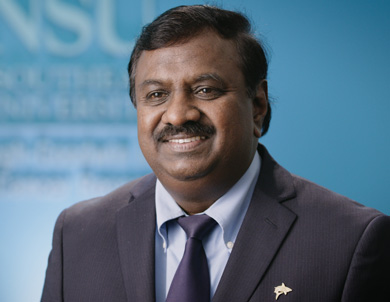
NSU’s Rumbaugh-Goodwin Institute for Cancer Research is led by Executive Director, Appu Rathinavelu, Ph.D. Dr. Rathinavelu holds several patents and has published more than 50 peer-reviewed research articles.
Dr. Rathinavelu received his Ph.D. in biochemistry from the University of Madras in India and conducted his postdoctoral training at Purdue University. He joined NSU's College of Pharmacy in 1992 and is currently Executive Director of the Rumbaugh-Goodwin Institute. Dr. Rathinavelu is the recipient of the prestigious 'Fulbright Award for Excellence in Teaching and Research'. He has served on the editorial board of several scientific journals and committees, co-authored a textbook and given more than 75 presentations at national and international conferences.
Appu Rathinavelu, Ph.D., executive director of NSU’s Rumbaugh-Goodwin Institute for Cancer Research and Associate Dean for Institutional Planning and Development at Nova Southeastern University’s College of Pharmacy.
 Research Achievements
With the unwavering support from the Royal Dames, RGI holds the distinction of being the only Research Institute at NSU with five patents for a single invention. All five of the patents are for the discovery of new cancer therapeutics that were codenamed as “JFD” in 2010. Taking this new drug to patients’ bedsides anywhere in the world would be one of RGI's missions for the near future. RGI is working very closely with Dr. Thomas Temple to find targeted therapies for treating children with sarcomas (bone cancers). As part of this initiative, an oncogene called MDM2, which Dr. Rathinavelu's team has researched for nearly 15 years, is being evaluated at RGI as an effective target for safer treatment of bone cancers in children. This new initiative is named “Translating Discovery to Cure Children with Cancer”.
NIH (National Institute of Health) Funded Scientist Joins RGI
Dr. Dmitriy Minond, Ph.D., former Associate Professor at Auburn University, joined RGI in 2017. He will be working with Dr. Rathinavelu to repurpose FDA-approved drugs currently in clinical use. This takes existing drugs to a patient's bedside in an accelerated manner compared to newer drugs not yet approved by the FDA. He will also be collaborating with the Scripps Research Institute of Florida and other institutions to discover new drugs that treat melanoma.
Grants
RGI has submitted three grant proposals since the beginning of 2017. These include the last proposal that was submitted to NCI, which seeks funds to support research related to the development of new immunotherapeutics.
New Collaborations
RGI is in the process of establishing collaborations with the H2Bio of Fort Lauderdale, FL. As part of this new collaboration, RGI will be offering its expertise toward performing the pre-clinical testing of their new therapeutic drug, which is being tested for treating lung cancers.
Finding Better Treatment Options
Medical progress in the fight against cancer is happening, but never fast enough. Watch the first episode of TRED Talks, a video series brought to you by Nova Southeastern University Translational Research and Economic Development (TRED), to hear about how NSU researchers are rapidly developing newer and safer cancer therapies.
Visit the Rumbaugh-Goodwin Institute for Cancer Research chevron_right